Myopia management is a system, not a one-time fix
When a child's glasses get stronger every year, it is tempting to think the job is simply a new prescription. But the real concern in myopia is the eye growing too long from front to back, and the level it reaches by adulthood matters for long term eye health. Managing that well takes more than a yearly lens update. It takes precise measurement, a clear read on risk, a treatment matched to the child, and steady tracking to confirm it is working.
At Guildford Eye Clinic, our myopia control program is led by Dr. Lin and built around four pillars. Here is what each one is, and why it matters.
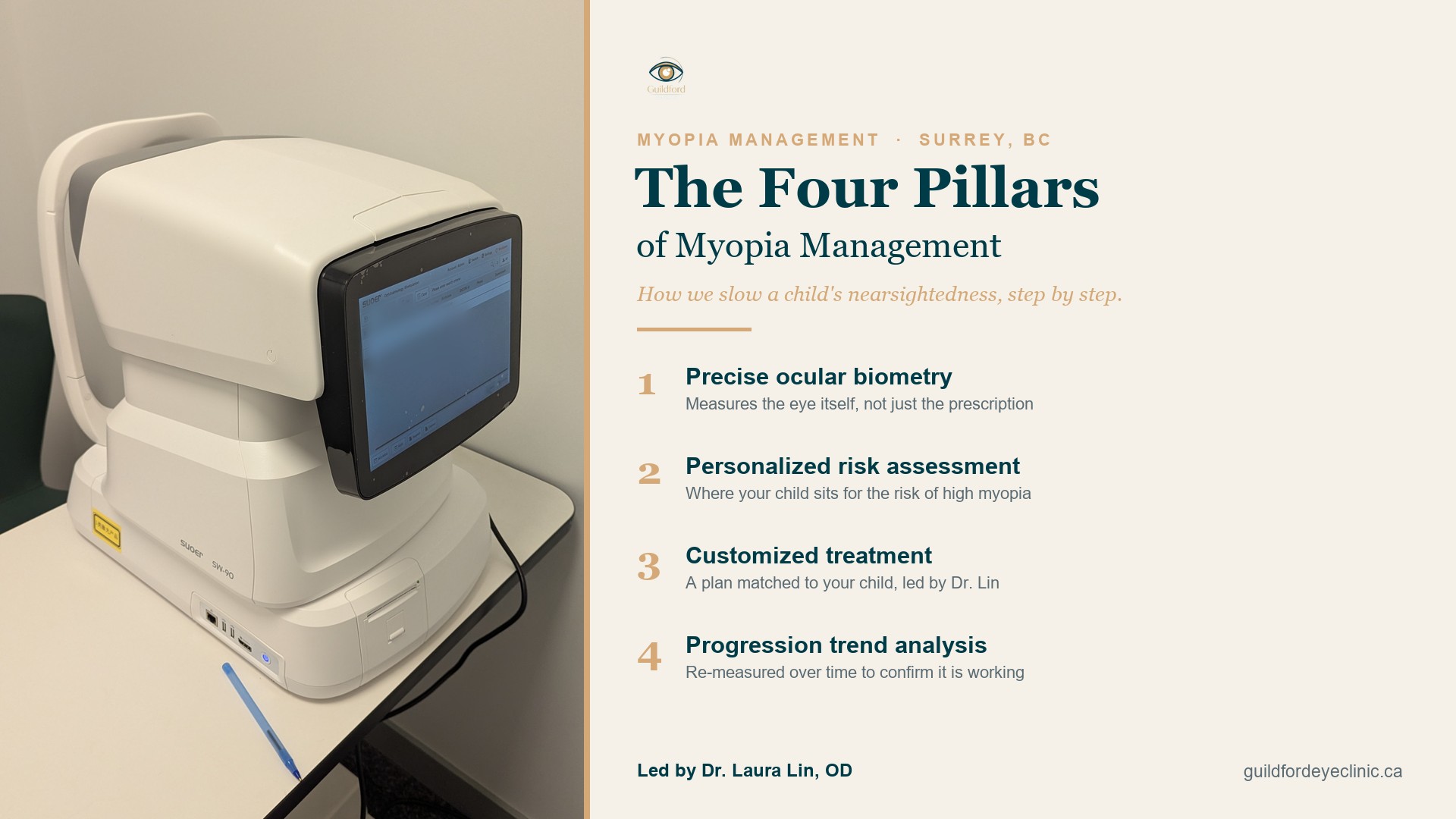
1. Precise ocular biometry
A detailed, no-contact scan of the eye itself, not just the prescription.
2. Personalized risk assessment
Where your child sits compared with peers for the risk of high myopia.
3. Customized treatment
A plan matched to your child, not a generic template.
4. Progression trend analysis
Tracking the numbers over time to confirm the treatment is working.
Pillar one: precise ocular biometry
Everything starts with measurement. Most eye exams estimate myopia from the glasses prescription alone, but the prescription only tells part of the story. Ocular biometry measures the eye itself.
Our biometer does more than capture the axial length, the front to back length of the eye that is the true driver of myopia. In the same quick scan, with nothing touching the eye, it also measures corneal thickness, anterior chamber depth, lens thickness, vitreous chamber depth, corneal curvature, and even pupil size. Together these give Dr. Lin a complete physical picture of how your child's eye is built and how it is changing, rather than a single number on a prescription. That fuller picture matters, because two children with the same prescription can have very differently shaped eyes, and those details help guide which treatments are likely to suit them.
Pillar two: personalized risk assessment
Not every nearsighted child faces the same future. Some progress slowly and level off. Others are on track for a high prescription that carries more long term risk. Telling them apart is what lets us treat appropriately rather than guess.
To do that, we combine several factors that influence how myopia tends to progress: the current prescription, the biometry measurements, and the child's age, gender, and ethnicity. From this we estimate where your child sits compared with peers, often expressed as a percentile for their risk of developing high myopia. This is an evidence based percentile analysis. It shows where your child is likely headed without action, and the right intervention can change that outcome. That is what turns a vague worry into something concrete we can act on and track over time.
Pillar three: customized treatment
There is no single best treatment for every child. Using the biometry results and the risk assessment, along with your child's age, daily routine, and comfort with lenses, Dr. Lin builds a recommendation tailored to that specific child.
The evidence based options we draw from include low dose atropine eye drops, soft multifocal contact lenses, and myopia control spectacle lenses such as MiyoSmart and Myoeye. A lower risk child might start with one approach, while a faster progressing child might need a stronger or combined plan. You can read more about how each of these options works in our myopia control guide. The point is that the plan fits the child, not a generic template.
Pillar four: progression trend analysis
Myopia management is not set and forget. We re-measure at regular visits and track the numbers, the prescription and especially the axial length, from month to month and year to year.
That trend line tells us what a single visit cannot: whether the treatment is actually slowing the eye's growth as intended. If the trend is on target, we stay the course. If a child is still progressing faster than we would like, we adjust the approach. This ongoing tracking is what turns a one-time treatment into a managed program, and it is the only way to know the plan is truly working for your child.
How the four pillars work together
Each pillar feeds the next. Biometry gives the precise measurements. The risk assessment turns them into a clear picture of where your child stands. The treatment is matched to that picture. The progression tracking checks our work and refines the plan over time. We will be publishing a detailed guide on each pillar soon.
For now, the first step is always the same: a comprehensive eye exam where we take your child's baseline measurements. A full exam is covered yearly by MSP for children 18 and under, and it includes OCT retinal imaging at no extra charge. The myopia control treatments themselves are a separate program and are not covered by MSP, but we direct bill most insurance plans and explain every cost clearly before anything begins. We are inside Specsavers at Guildford Town Centre, with easy mall parking, caring for the whole family in one place.
Surrey myopia management FAQ
What is ocular biometry, and why does it matter for myopia?
Ocular biometry is a quick, no-contact scan that measures the eye itself rather than estimating from the glasses prescription. Our biometer captures the axial length, which is the front to back length of the eye and the true driver of myopia, along with corneal thickness, anterior chamber depth, lens thickness, vitreous chamber depth, corneal curvature, and pupil size. Together these give a complete physical picture of how a child's eye is built and how it is changing over time.
How do you assess a child's risk of high myopia?
We combine several factors that influence how myopia tends to progress: the current prescription, the biometry measurements, and the child's age, gender, and ethnicity. From this we estimate where the child sits compared with peers, often expressed as a percentile for their risk of developing high myopia. It is an evidence based estimate that guides the plan. It shows where a child is likely headed without action, and the right intervention can change that outcome.
How do you choose which myopia treatment a child needs?
Using the biometry results, the risk assessment, and the child's age, daily routine, and comfort with lenses, Dr. Lin builds a recommendation tailored to that specific child. The evidence based options include low dose atropine eye drops, soft multifocal contact lenses, and myopia control spectacle lenses such as MiyoSmart and Myoeye. A lower risk child might start with one approach, while a faster progressing child might need a stronger or combined plan.
How often will my child be re-measured?
Myopia management is an ongoing program, not a one-time fix. We re-measure at regular visits and track the numbers, especially the axial length, from month to month and year to year. That trend tells us whether the treatment is slowing the eye's growth as intended, so we can stay the course or adjust the approach.
Is the myopia program covered by MSP in BC?
A full eye exam is covered yearly by MSP for children 18 and under, and that exam is where we take the baseline measurements and assess whether myopia management is right for your child. The myopia control treatments themselves are a separate program and are not covered by MSP. We direct bill most insurance plans and explain all costs clearly before starting.
This article is for general education and is not a substitute for a personalized eye examination. Sources include the International Myopia Institute reports and published clinical trials on low concentration atropine, soft multifocal contact lenses, and myopia control spectacle lenses.