Short answer first
A children's eye test in Surrey should be more than reading a chart. At every age, a full kids eye exam checks how clearly each eye sees, how the eyes focus and work together, and how healthy the eyes are inside. What changes with age is how we check: picture and shape charts for preschoolers, letters and reading tasks for school-age kids, and screen habits, sports, and contact lens questions for teens.
We recommend a first eye exam around age 3, or sooner if anything seems off, and then yearly. A routine eye exam is covered yearly by MSP for children 18 and under. At Guildford Eye Clinic, inside Specsavers at Guildford Town Centre, our doctors see children of all ages, and our children's eye exam in Surrey page explains what is included. This guide walks through what a children's eye test looks at, age by age, so you know what to expect before you book.
Eye test, screening, or full eye exam: what is the difference?
Parents use these words in different ways, so it helps to separate them:
- A vision screening (often at school or a community event) is a quick check of whether a child can see the chart at a distance. It is useful, but it is short by design.
- An "eye test" usually means the same thing people picture: reading letters on a wall. On its own, it tells you about sharpness of vision, not much else.
- A full children's eye exam with an optometrist checks vision at distance and up close, focusing, eye teaming and tracking, eye alignment, colour vision when it is useful, the glasses prescription, and the health of the front and back of the eye.
A child can pass a screening and still struggle with reading, headaches, or tired eyes after homework. That is why we suggest a full exam every year even when the school screening came back fine. Parents due for their own check can read how an eye test differs from a full eye exam. Our guide on how to choose a kids optometrist in Surrey covers what a good visit should include.
Ages 3 to 5: the first eye exam
Young children rarely say "I can't see well." They assume everyone sees the way they do. The first exam is about finding problems that are easiest to help when caught early.
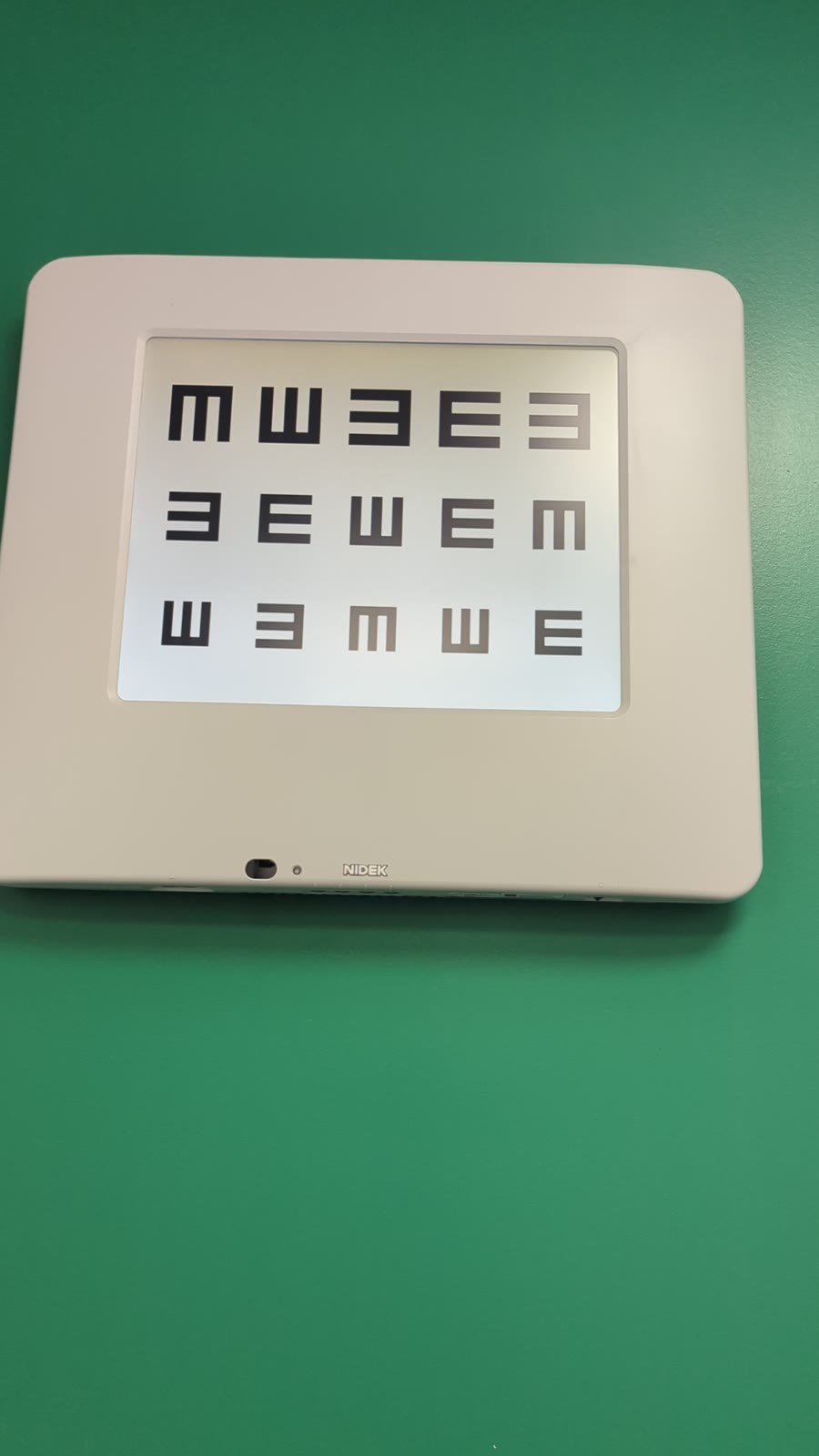
- No reading needed. We use pictures, shapes, or the tumbling E chart, where a child points the way the "legs" of the E face. Many preschoolers treat it like a game.
- Eye alignment. We check whether the eyes point together, and look for an eye that turns in or out, even now and then.
- A "lazy eye" check. We compare the two eyes, because one eye can see much less clearly than the other without the child noticing.
- Focusing and prescription. Young eyes can work hard to focus, so the doctor uses methods that do not depend on the child's answers alone.
- Eye health. A look at the front of the eye, the retina, and the optic nerve, kept gentle and quick.
Short visits work best for this age. Bring a favourite snack or toy, and plan around naps if you can. Parents stay in the room, and the doctor explains what they found in plain words before you leave.
Ages 6 to 12: school, reading, and screens
Once school starts, eyes do a lot of close work: reading, worksheets, tablets, and copying from the board. A children's eye test at this age adds tasks that match that load:
- Distance and near vision with letter charts, so we know how the board and the page both look.
- Eye teaming and tracking. How well the eyes move together along a line of text and stay together up close.
- Focusing stamina. Whether focus holds steady through reading, or tires and blurs.
- Prescription changes. This is the age when nearsightedness (myopia) often starts or speeds up, so yearly exams help us notice change early.
- Eye health, including OCT retinal imaging, which is included in every comprehensive exam at our clinic. An early scan becomes a baseline that later exams can compare against.
Common signs parents tell us about at this age: squinting at the tablet, sitting very close to the TV, rubbing eyes after homework, losing their place while reading, covering one eye, headaches after school, or a teacher noticing trouble seeing the board. Any of these is a good reason to book rather than wait for the next screening.
If your child's glasses get stronger every year, ask about our myopia control program in Surrey, led by Dr. Laura Lin. Dr. Samantha Feng also has a special interest in myopia management. The kids exam itself is the starting point; myopia control is a separate conversation if it fits your child. Our guide to how myopia management works for kids walks through each step.
Ages 13 to 18: teens, sports, and contact lenses
Teens are often the hardest to bring in, and the most likely to have put up with blur without saying anything. Their exam covers the same core checks plus questions that matter more now:
- Screen time and study load. Long hours on phones and laptops can leave eyes tired or dry by evening. We talk about breaks and habits that help.
- Sports and activities. Clear vision without glasses fogging or slipping can make a difference for some teens.
- Contact lenses. Many teens ask about them. Wearing contacts needs a contact lens exam and fitting on top of the eye exam, with training on safe wear and care.
- Driving. For older teens getting ready to drive, a clear and current prescription is worth checking first.
MSP covers a routine eye exam yearly up to and including age 18, so the teen years are a good time to keep the habit going before adult pricing applies.
Signs a child should have an eye exam sooner
You do not need to wait for the yearly visit if you notice:
- An eye that turns in, out, up, or down, even occasionally
- Tilting the head or covering one eye to look at something
- Squinting, frequent blinking, or eye rubbing
- Holding books or screens very close
- Headaches or tired eyes after reading or screens
- Avoiding reading or close work, or losing their place on the page
- A family history of lazy eye, eye turns, or strong glasses in childhood
These signs do not mean something is wrong. They mean it is worth a proper look so you know either way. We cannot tell what is going on from a description alone, but a full exam can.
What a children's eye test costs in BC
A routine eye exam is covered yearly by MSP for children 18 and under, and we bill MSP directly. Glasses and contact lenses are not covered by MSP, but many extended health plans help with them. If a parent is due too, a comprehensive exam is $99 for adults with MSP, with OCT included, and booking back to back times keeps it to one trip. Our guide to eye exam cost in BC and MSP coverage explains coverage by age, and the MSP kids eye exam questions post answers the common coverage questions in more detail.
What to bring: your child's BC Services Card, any extended health plan details, current glasses (even ones they do not wear much), and notes on anything you or the teacher have noticed. The front desk explains your part of any cost before the exam starts.
Booking a children's eye test at Guildford Town Centre
After-school and Saturday times are popular with families. We offer evening appointments until 7 PM on most days, Monday to Saturday, so many parents can bring kids after school or activities without pulling them out of class. Check online booking for the latest times, or call (604) 229-9627.
Our doctors can check eyes in English, Mandarin, or Punjabi, and Cantonese is available with Dr. Samantha Feng. Korean is spoken too. Grandparents who bring kids in can hear the results in a language they are comfortable with. See our Mandarin-speaking optometrist and Punjabi-speaking optometrist pages for more.
We are on the second floor of Guildford Town Centre, inside Specsavers, near Scotiabank and London Drugs: Unit 2309, 10355 152 Street, Surrey, BC V3R 7C1, with free mall parking. Families come from across Surrey and nearby communities. Guildford Eye Clinic is an independent optometry clinic run by Dr. Lin and Dr. Xue Optometry; Specsavers is the retail dispensary in the same space. If a parent is also overdue, book an eye exam in Surrey at the same visit. Our first visit guide has parking and directions.
When a child's eye problem should not wait
Call us right away at (604) 229-9627 for a red, painful, or sticky eye, an eye injury, something stuck in the eye, a chemical splash (rinse with clean water first), or a sudden change in vision. A medically necessary visit costs the same as a regular exam and is covered by MSP for kids. For a serious injury, go to the nearest emergency department or call 911. Our emergency eye care page has more.
Children's eye test FAQ
What does a children's eye test check?
A full children's eye exam checks how clearly each eye sees at distance and up close, how the eyes focus, team and track together, eye alignment, the glasses prescription, and the health of the front and back of the eye. OCT retinal imaging is included in every comprehensive exam at Guildford Eye Clinic.
What age should a child have their first eye exam?
We recommend a first eye exam around age 3, or sooner if anything seems off, such as an eye that turns, and then yearly after that.
Can a child who cannot read have an eye test?
Yes. For young children we use pictures, shapes, or the tumbling E chart, where a child points the way the E faces. The doctor also uses methods that do not depend on the child's answers alone.
Is a school vision screening the same as an eye exam?
No. A school screening is a quick check of distance vision. A full eye exam also checks focusing, eye teaming, alignment and eye health, and can find problems a screening is not designed to catch.
Are children's eye exams covered by MSP in BC?
Yes. A routine eye exam is covered yearly by MSP for children 18 and under, and we bill MSP directly. Glasses and contact lenses are not covered by MSP, but many extended health plans help with them.
What signs mean my child should have an eye exam sooner?
An eye that turns, tilting the head or covering one eye, squinting or eye rubbing, holding screens very close, headaches after reading, avoiding close work, or losing their place on the page. These do not mean something is wrong, but they are worth a proper look.
Can my child have an eye test after school?
Yes. We offer evening appointments until 7 PM on most days, Monday to Saturday. After-school and Saturday times are popular, so check online booking at specsavers.ca/booking?store_id=22 for the latest times.
Can the eye exam be done in Mandarin, Punjabi or Cantonese?
Yes. Our doctors can check eyes in English, Mandarin, or Punjabi, and Cantonese is available with Dr. Samantha Feng. Add a note when you book online or tell the front desk when you call.
What should I bring to my child's eye exam?
Your child's BC Services Card, any extended health plan details, current glasses, and notes on anything you or the teacher have noticed.
This article is for general education and is not a substitute for a personalized eye examination or emergency care. Coverage and MSP rules can change; confirm coverage when you book. If your child has a serious eye injury or sudden vision loss, call 911 or go to the nearest emergency department.